
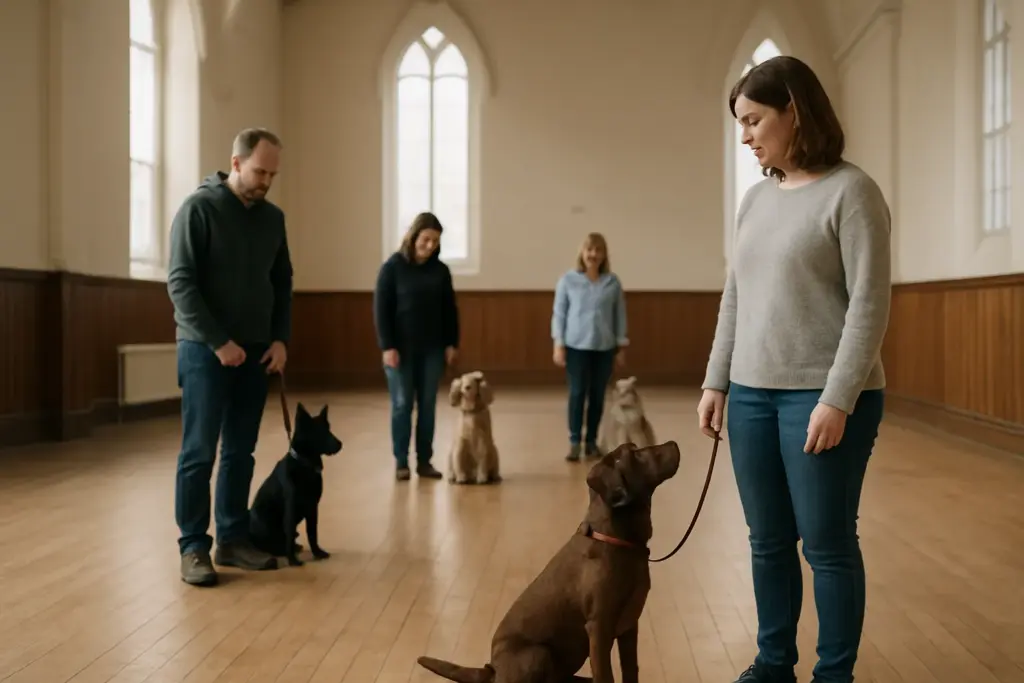
You’ve had the tab open for a fortnight. You know your dog needs a first dog training class, you’ve almost booked one twice, and something always talks you out of it at the last second. Usually it’s one thought: everyone else’s dog will be perfect and yours will bark the roof off. Here’s what to expect from a first class at Back To Basics, so you can walk in knowing what’s coming.
Booking your first dog training class
Booking is the easy part. You call, text, WhatsApp or send a message through the contact page, tell us a bit about your dog, and ask which class suits: Puppy Foundations, Intermediate or Advanced, or 1:1 training if that’s a better fit.
If you’re booking a puppy class, Back To Basics emails joining instructions on what to bring before your first session. Read them properly, even the bits that feel obvious, and if anything doesn’t make sense, ask beforehand rather than working it out on the doorstep.
Walking into Fulwell Methodist Church
Group classes run at Fulwell Methodist Church in Seaburn, in a calm, friendly hall.
If your dog is pulling towards every other dog in the room, or hanging back behind your legs, that’s completely normal for a first visit, and the team has 40+ years’ combined experience between them. Nobody’s grading you on how your dog behaves in the first thirty seconds. That’s what the class is for.
Dogs need room to settle before they’re ready to work, so take your time finding your feet.
Back To Basics trainers watch body language and vocal tone closely to bring out the best in each dog, so if you’re unsure whether your dog is coping, ask. If your dog’s too wound up to take treats, giving it a minute is usually better than pushing on.
What actually happens in your first 45 minutes
Sessions run 45 minutes. It’s sensible to treat a first class as being mostly about your dog getting used to a room full of other dogs and staying calm enough to think, not about hitting perfect behaviour on day one.
Your dog will probably need some settling time before any real work. Back To Basics describes its training as positive and kind, which matters for a dog who’s nervous or overexcited.
Whatever level you’re in, a dog that spends a first session mostly settling is still learning something useful.
The part nobody warns you about
Here’s the bit that doesn’t make it into anyone’s glossy description of a first class: it’s normal for a dog to do almost nothing useful in week one.
Some dogs spend the whole session sniffing the floor, staring at the door, or glued to your leg refusing a treat they’d normally fight you for. New sounds, new smells, a dozen other dogs, it’s a lot to process at once, and asking a dog to learn something new on top of all that is asking too much on day one.
Week one is about your dog working out that this room is safe, not scary. That’s the actual job, even if it doesn’t look like training from the outside. Some dogs open up more over the following weeks, once the hall stops being a novelty and starts being familiar. Some take longer, and that’s fine too. It isn’t a sign you’ve picked the wrong class, or the wrong dog.
You will not be the worst dog there
It’s easy to walk in convinced your dog is about to be the worst one in the hall.
Puppy Foundations takes puppies six months and under. Intermediate and Advanced classes are where puppies progress once they’re ready, so every dog in them started somewhere.
You’re not being judged against some imaginary perfect dog. You’re being met where your dog actually is this week, and helped along from there. That’s the whole point of a class instead of a book or a video.
My dog barks. Will we ruin it for everyone?
This is the other big one, and it deserves an honest answer rather than a brush-off: tell the trainers about the barking when you book, and ask how they’d handle it.
Space helps, so tell us about your dog when you book and ask for advice on the best way to start.
If your dog is properly reactive rather than just a bit noisy on the day, a group class isn’t always the right starting point, and that’s worth saying plainly. A 1:1 session gives a nervous or reactive dog space to work without an audience, and it’s often the better first step before joining a group. Say so before you book if you’re unsure. Describing what actually happens on your walks helps us point you at the right one, rather than you guessing and hoping.
What to bring, and what to leave at home
Bring your dog on a lead, a decent supply of treats and some water, and you’ve covered the basics. For the lead, a normal fixed-length lead is easier to manage in a packed hall than a retractable one, which gives you far less control exactly when you need it, with other dogs and excited owners moving around close by.
Treats matter more than people expect. Bring something your dog genuinely loves, not the biscuit that’s been sitting in the cupboard since Christmas. Little and often works best, so go for something soft you can break into pea-sized pieces rather than a handful of big crunchy ones. Feed your dog a lighter meal before class rather than a full one, too; a dog who’s a bit hungry works harder for a treat than a dog who’s just eaten.
For puppy classes, the joining instructions emailed before your first session cover exactly what to bring, so treat this as the general shape.
From Puppy Foundations to graduation day
A first class isn’t a one-off. It’s the start of a path. Puppy Foundations is for puppies up to six months: socialisation, bite inhibition, early recall and good manners. When they’re ready, puppies can progress through Intermediate and Advanced classes.
Dogs move through the levels at their own pace, and every graduate gets their moment.
Back To Basics trains dogs across Sunderland, Whitburn and South Shields, with group classes in Seaburn. Your first dog training class is just the first rung. Nobody expects you to arrive anywhere near the top of it.
FAQs
What should I bring to my first dog training class?
Your dog on a lead, a good supply of small, soft treats and some water. For puppy classes, joining instructions are emailed before your first session, so read those properly too.
What age can my puppy start?
Puppy Foundations is for puppies up to six months. Intermediate and Advanced classes, plus 1:1 training, are for dogs of all ages.
Do I need to book before I turn up?
Yes, get in touch first by phone, WhatsApp or through our contact page to book the right class.
What if my dog has never been around other dogs before?
That’s exactly what Puppy Foundations is for: controlled socialisation is part of what it covers. For an older dog, ask whether a group class or 1:1 is the better start.
Is a training class suitable for a reactive or nervous dog?
It depends on the dog, so ask. Back To Basics offers patient, kind support for nervous, reactive or fearful dogs. For dogs who are more seriously reactive, a 1:1 session first is usually the kinder, more effective starting point. Tell us honestly what your walks look like and we’ll advise you properly.
Want a hand with it?
If you’ve been putting off booking a first dog training class because you’re not sure which level fits, that’s an easy one to sort out. Send us a message through our contact page describing your dog, puppy, adolescent or an older dog who’s never been to a class, and we’ll tell you honestly whether Puppy Foundations, Intermediate or Advanced is the right starting point. Ready to see what’s running? Check the current classes and timetable and come and train with us in Sunderland.